
Deer Tick (Black-Legged Tick) Control:
Understanding the Deer Tick Threat in Middle Tennessee
While deer ticks (Ixodes scapularis), also known as black-legged ticks, are less common in Middle Tennessee than lone star or American dog ticks, their presence poses a unique and serious health concern. As the primary vector for Lyme disease in the United States, even a small population of deer ticks demands attention and professional management.
At Armor Termite and Pest Control, we’ve observed an increase in deer tick encounters in the Mt. Juliet and greater Nashville areas, particularly in properties adjacent to wooded areas and those frequented by white-tailed deer. Understanding and controlling these ticks is crucial for protecting your family from Lyme disease and other tick-borne illnesses.
Why Deer Ticks Matter
Despite lower numbers compared to other tick species, deer ticks present outsized risks:
- Primary Lyme disease vector in North America
- Year-round activity possible in Tennessee’s climate
- Small size makes detection difficult
- All mobile stages (larvae, nymphs, adults) can transmit diseases
The Tennessee Department of Agriculture urges awareness during tick season, noting risks to livestock, pets, and people. For additional guidance, see Livestock and Pet Owners Should Be Aware of Tick Season in Tennessee from the Tennessee Department of Agriculture.
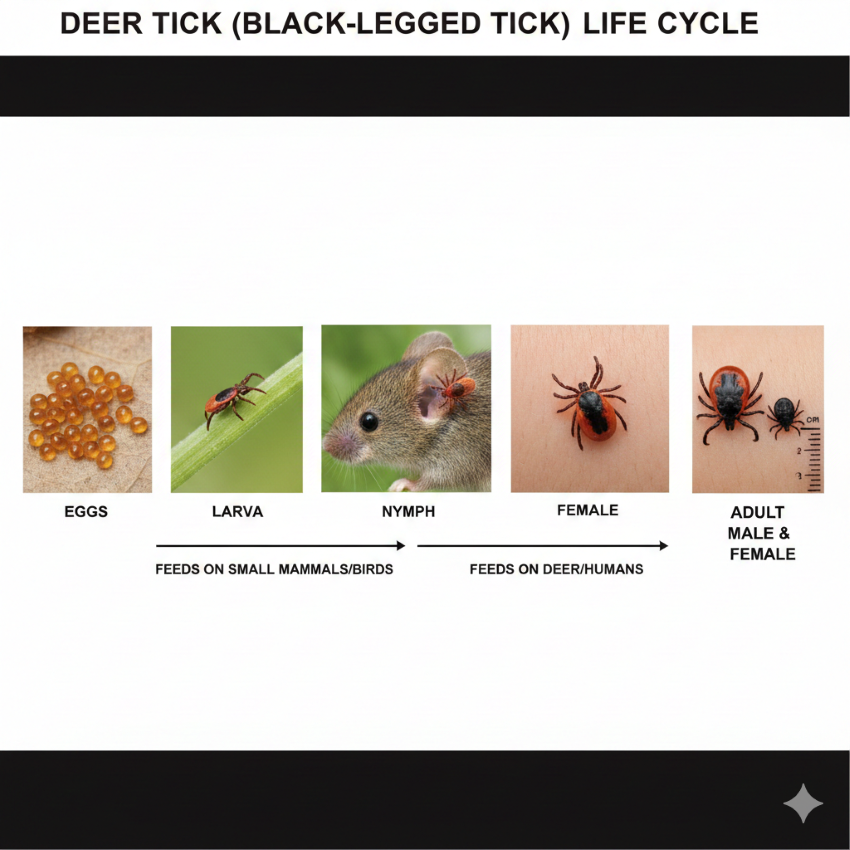
Deer Tick (Black-Legged Tick) Identification & Life Cycle
| Life Stage / Feature | Details |
|---|---|
| Adult Female | 3–5 mm when unfed; up to 10 mm when engorged |
| Adult Male | 2–3 mm; does not engorge |
| Nymph ⚠️ Most Dangerous | 1–2 mm (poppy-seed size); responsible for most Lyme disease transmission |
| Larvae | Less than 1 mm (pinhead size) |
| Body Color | Reddish-brown body with dark legs |
| Female Marking | Reddish-orange area behind the dorsal shield |
| Male Coloring | Dark brown to black |
| White Dot | ❌ None (unlike lone star ticks) |
| Mouthparts | Long relative to body size, increasing disease transmission risk |
Deer Tick Life Cycle & High-Risk Seasons in Mt. Juliet, TN
| Season | Activity |
|---|---|
| Spring–Summer | Eggs hatch into larvae |
| Larvae feed on mice and birds | |
| Larvae molt into nymphs | |
| Fall–Winter | Adult ticks begin emerging |
| Adults remain active on warm days above 35°F |
Call Now for a Tick Treatment!
Contact Information
6160 Hampton Hall Way
Hermitage, Tennessee, 37076, United States
Mon-Fri
8:00 AM - 5:00 PM
Sat
8:00 AM - 12:00 PM
Sun
Closed